
Close Menu
    Facebook X (Twitter) Instagram
    SciTechDaily
    • Biology
    • Chemistry
    • Earth
    • Health
    • Physics
    • Science
    • Space
    • Technology
    Facebook X (Twitter) Pinterest YouTube RSS
    SciTechDaily
    Home»Health»Scientists Reveal Genetic Mechanism Linked to High-Calorie Food-Fueled Obesity
    Health

    Scientists Reveal Genetic Mechanism Linked to High-Calorie Food-Fueled Obesity

    By Osaka Metropolitan UniversityFebruary 4, 20233 Comments3 Mins Read
    Facebook Twitter Pinterest Telegram LinkedIn WhatsApp Email Reddit
    Share
    Facebook Twitter LinkedIn Pinterest Telegram Email Reddit
    Hamburger Unhealthy Junk Food Obesity
    Obesity is a growing global health concern, affecting millions of people worldwide. One of the major contributors to obesity is the consumption of high-calorie foods.

    Researchers have identified that CRTC1 in MC4R neurons helps regulate overeating of high-fat foods.

    High-calorie foods—high in fat, oil, and sugar—often taste delicious but can also cause overeating, leading to obesity and major health problems. But what stimulates the brain to cause overeating?

    Recently, it has become clear that a gene called CREB-Regulated Transcription Coactivator 1 (CRTC1) is associated with obesity in humans. Studies on mice have shown that deleting CRTC1 results in obesity, suggesting that its presence suppresses the condition. However, the specific neurons responsible for suppressing obesity through CRTC1 and the mechanism behind it are still unknown, as the gene is expressed in all neurons in the brain.
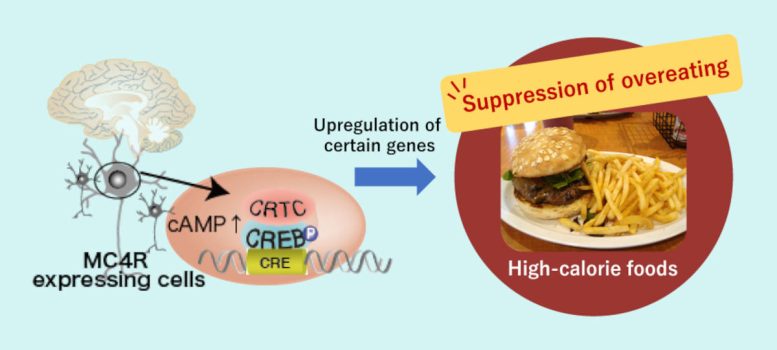
    Mechanism by Which CREB Regulated Transcription Coactivator 1 (CRTC1) Suppresses Overeating
    Osaka Metropolitan University scientists have revealed that the transcription cofactor gene CRTC1 mediates the obesity-suppressing effects of melanocortin-4 receptor (MC4R) by regulating appetite for fats and oils, high-fat diet metabolism, and blood sugar. Credit: Shigenobu Matsumura, Osaka Metropolitan University

    To elucidate the mechanism by which CRTC1 suppresses obesity, a research group led by Associate Professor Shigenobu Matsumura from the Graduate School of Human Life and Ecology at Osaka Metropolitan University focused on neurons expressing the melanocortin-4 receptor (MC4R). They hypothesized that CRTC1 expression in MC4R-expressing neurons suppressed obesity because mutations in the MC4R gene are known to cause obesity. Consequently, they created a strain of mice that expresses CRTC1 normally except in MC4R-expressing neurons where it is blocked to examine the effect that losing CRTC1 in those neurons had on obesity and diabetes.

    When fed a standard diet, the mice without CRTC1 in MC4R-expressing neurons showed no changes in body weight compared to control mice. However, when the CRTC1-deficient mice were raised on a high-fat diet, they overate, then became significantly more obese than the control mice and developed diabetes.

    “This study has revealed the role that the CRTC1 gene plays in the brain, and part of the mechanism that stops us from overeating high-calorie, fatty, and sugary foods,” said Professor Matsumura. “We hope this will lead to a better understanding of what causes people to overeat.”

    Reference: “CRTC1 deficiency, specifically in melanocortin-4 receptor-expressing cells, induces hyperphagia, obesity, and insulin resistance” by Shigenobu Matsumura, Motoki Miyakita, Haruka Miyamori, Satomi Kyo, Fuka Ishikawa, Tsutomu Sasaki, Tomoki Jinno, Jin Tanaka, Kotomi Fujita, Takumi Yokokawa, Tsuyoshi Goto, Keiko Momma, Shigeo Takenaka and Kazuo Inoue, 9 November 2022, The FASEB Journal.
    DOI: 10.1096/fj.202200617R

    The study was funded by the Takeda Life Science Foundation, the Sugiyama Sangyo-Kagaku General Incorporated Foundation, and the Japan Society for the Promotion of Science.

    Never miss a breakthrough: Join the SciTechDaily newsletter.
    Follow us on Google and Google News.

    Brain Genetics Nutrition Obesity Osaka Metropolitan University Popular Weight Gain
    Share. Facebook Twitter Pinterest LinkedIn Email Reddit

    Related Articles

    New Research Reveals That This Popular Spice Has Powerful Anti-Obesity Effects

    Just 3 Days of Fatty Food May Damage Aging Brains, Study Warn

    New Research Uncovers Brain’s Hidden Role in Triggering Obesity

    Obesity May Permanently Change the Brain – Yale Study Finds Severely Impaired Response to Nutrients

    Green Mediterranean Diet: How Eating Healthy Can Make Your Brain Younger

    Scientists Discover That Eating Too Much During Development Permanently Alters the Brain

    Ketone Supplements May Protect and Improve Brain Health in People With Obesity

    Scientists Discover a Gene to Stay Thin – Protects Against Diet-Induced Obesity

    Most Widely Used Cooking Oil Causes Genetic Changes in the Brain

    3 Comments

    1. Dan on February 6, 2023 12:01 am

      I’m confused about the paragraph that talks about mice without CRTC1 in MC4R-expressing neurons.

      When fed a standard diet, they were not obese. When fed a high-fat diet, they were obese.

      It sounds like the diet, not the absence of the gene, resulted in obesity. At the very least, it sounds like a high-fat diet triggered the overeating, which is still the diet as the cause.

      I remember reading a study many years ago that suggested carbohydrates trigger a reward response in the brain, but the study did not explain why some people can stop eating when they’re full and some cannot.

      I remember yet another study talking about cultural influence, namely the 1980s where exercise and nice bodies were influencing people to get in better shape or at least be health-conscious.

      I think the issue of obesity is more complex than a gene. The question is how or whether we can actually use the discovery to treat obesity, because all the fat-shaming activists do is point to something to distract from personal accountability to maintain a sense of victimhood. None of this helps the people who have obesity.

      Reply
    2. Rajeev Samuel on February 6, 2023 8:13 am

      Carbohydrates combined with Poly-Unsaturated fats (PUFA / VARNISH -> soybean/safflower/sunflower/corn/seasame/canola/flaxseed/cottonseed/linseed) directly cause cancer, diabetes, heart disease, liver disease, obesity and dementia.

      Reply
    3. Ashwin Campbell on November 24, 2024 8:16 pm

      Living can lead to a myriad of cancers and diseases, dementia, and also premature death.

      Reply
    Leave A Reply Cancel Reply

    • Facebook
    • Twitter
    • Pinterest
    • YouTube

    Don't Miss a Discovery

    Subscribe for the Latest in Science & Tech!

    Trending News

    Scientists Discover 132-Million-Year-Old Dinosaur Tracks on South Africa’s Coast

    Scientists Uncover the Secret Ingredient Behind the Spark That May Have Started Life on Earth

    Physicists Observe Matter in Two Places at Once in Mind-Bending Quantum Experiment

    Stanford Scientists Discover Hidden Brain Circuit That Fuels Chronic Pain

    New Study Reveals Why Ozempic Works Better for Some People Than Others

    Climate Change Is Altering a Key Greenhouse Gas in a Way Scientists Didn’t Expect

    New Study Suggests Gravitational Waves May Have Created Dark Matter

    Scientists Discover Why the Brain Gets Stuck in Schizophrenia

    Follow SciTechDaily
    • Facebook
    • Twitter
    • YouTube
    • Pinterest
    • Newsletter
    • RSS
    SciTech News
    • Biology News
    • Chemistry News
    • Earth News
    • Health News
    • Physics News
    • Science News
    • Space News
    • Technology News
    Recent Posts
    • Naturally Occurring Bacteria Completely Eradicate Tumors in Mice With a Single Dose
    • The Ideal Temperature for Storing Mangoes Isn’t What You Think
    • Groundbreaking Enzyme Atlas Rewrites Decades of Biology Research
    • New “Nanozyme Hypothesis” Could Rewrite the Story of Life’s Origins
    • Anatomy Isn’t Finished: The Human Body Still Holds Secrets
    Copyright © 1998 - 2026 SciTechDaily. All Rights Reserved.
    • Science News
    • About
    • Contact
    • Editorial Board
    • Privacy Policy
    • Terms of Use

    Type above and press Enter to search. Press Esc to cancel.